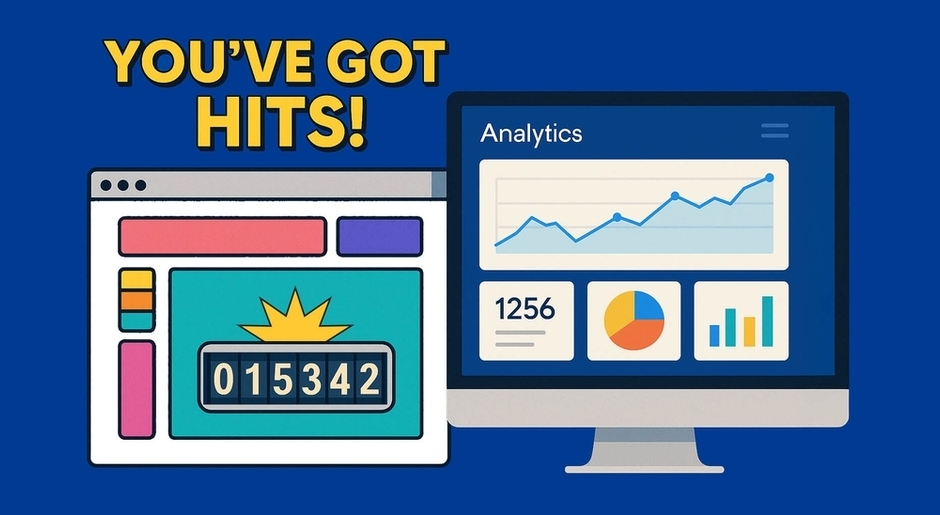
If you browsed the internet in the late 90s or early 2000s, you probably noticed a little box at the bottom of many websites displaying a number that slowly ticked upward. This was the hit counter, one of the earliest and most basic ways webmasters tracked traffic to their sites. It was a badge of honor, a public-facing metric that showed how many visitors had stopped by. Today, tools like Google Analytics 4 offer deep insights into user behavior, engagement, and conversion rates, making hit counters a relic of a simpler time.
Hit Counters: A Symbol of Early Web Popularity
Hit counters were essentially digital odometers for websites. They worked by incrementing a number each time someone visited a page. While they gave site owners a sense of popularity, they lacked nuance; there was no distinction between unique visitors and repeat clicks, and they provided no context for user behavior. Still, having a high number was a point of pride, and many webmasters displayed their counters prominently as proof that people were visiting their site.
The Limitations of Hit Counters
As web traffic tracking evolved, the flaws of hit counters became more apparent. They couldn’t tell webmasters anything about user demographics, how long visitors stayed, or what they interacted with. They also lacked accuracy; many were easily manipulated by refreshing the page repeatedly. For businesses and serious website owners, a simple counter wasn’t enough to measure meaningful engagement.
The Rise of Modern Web Analytics
As websites became more sophisticated, so did tracking methods. Log file analysis and early analytics tools provided more granular data, but it wasn’t until Google Analytics launched in 2005 that website tracking truly transformed. Over time, tools like Google Analytics 4 have introduced advanced features such as event tracking, audience segmentation, heatmaps, and AI-driven insights. Instead of just knowing how many people visited a site, businesses can now track user behavior, conversion rates, and detailed traffic sources... all in real time.
Why Simplicity Still Has Its Charm
Despite the power of modern analytics, there’s a certain nostalgia for the simplicity of hit counters. They represented an era when the internet was less about data-driven strategies and more about personal expression. Today, some retro-themed websites still include hit counters as a nod to the past, but they serve more as an aesthetic choice than a functional tool.
Looking Ahead
At WRIS, we understand the importance of data-driven decision-making while appreciating the history of web development. Whether you're looking to implement modern analytics tools or just want to reflect on how far the web has come, we’re here to help. Reach out to us to explore how advanced analytics can drive smarter web strategies and improve your digital presence.
Related Blogs
Before Google: The Wild West of Early Search Engines

WRIS at Adobe ColdFusion Summit 2026: Innovation, AI, and Community
.jpg&w=640&h=360&c=center)
What ADA Compliance Actually Means for Your Website in 2026
.jpg&w=640&h=360&c=center)